

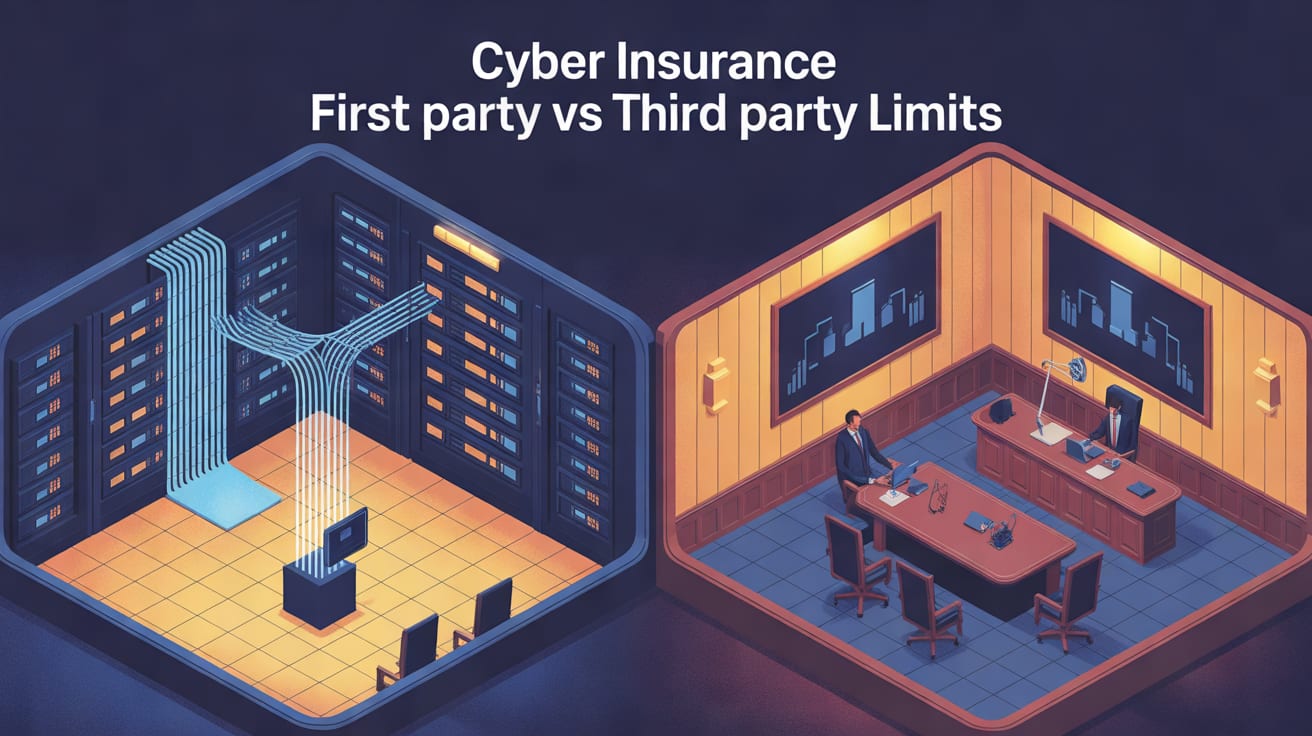
At Jodimorrisinsurance, understanding cyber insurance first party vs third party limits requires separating internal recovery costs from external liability claims. First-party coverage compensates your business for direct financial losses like ransomware payouts and operational downtime, while third-party coverage pays for legal defense, customer notification, and regulatory penalties stemming from affected partners or clients.
Table of contents
- What is the core difference between cyber insurance first party vs third party coverage?
- How do first-party cyber insurance triggers cover ransomware and business interruption?
- How do third-party cyber insurance claims handle regulatory fees and client lawsuits?
- How should businesses structure their cyber insurance first party vs third party limits?
- Frequently asked questions
What is the core difference between cyber insurance first party vs third party coverage?
First-party cyber insurance covers direct loss and operational expenses incurred by your own business during a security event, whereas third-party cyber insurance covers financial liabilities and legal claims asserted against your company by outside entities. Knowing how these two pillars operate determines how a business recovers after an incident.
First-party coverage acts as immediate emergency response funding. When servers are encrypted or data is corrupted, first-party provisions pay for specialized digital forensics teams to identify the breach vector, crisis communications consultants to manage reputational damage, and technical personnel to rebuild compromised databases. It also addresses direct financial loss through business interruption indemnification.
Third-party coverage functions as liability defense. If external clients, partners, or government bodies suffer damages because your system exposed confidential record sets, third-party provisions fund your legal defense, court-ordered settlements, contractual penalties, and statutory regulatory compliance fines.
Defining these terms precisely prevents coverage gaps:
- First-Party Cyber Coverage: Policy provisions that indemnify the named insured for direct loss, restoration costs, and operational disruption expenses resulting from a network security failure or data breach.
- Third-Party Cyber Coverage: Policy provisions that indemnify the named insured against civil litigation damages, defense counsel fees, regulatory assessments, and settlement costs arising from third-party claims of data privacy negligence.
How do first-party cyber insurance triggers cover ransomware and business interruption?
First-party cyber insurance triggers activate when a malicious network intrusion directly disrupts your business operations or encrypts critical data systems. The policy responds through specific insuring agreements designed to restore technical operations and replace lost operating revenue.
Ransomware Payment Limits and Sub-Limits
Extortion coverage handles demands made by malicious actors threatening to ruin data or publish confidential corporate information. However, policy language rarely matches extortion demands dollar-for-dollar due to policy sub-limits.
A sub-limit is a policy provision that caps payout for a specific type of loss below the overall policy aggregate. For instance, a policy might provide a $2,000,000 total policy limit but impose a $250,000 sub-limit on extortion losses. If a threat actor demands a higher ransom, the insurer only pays up to the sub-limit.
Ransomware coverage also incorporates specific operational conditions:
- OFAC Compliance Checks: Insurers cannot legally reimburse ransom payments paid to entities on sanctioned lists maintained by government agencies. Sanction screening must occur before funds are wired.
- Co-Insurance Requirements: Certain policies require the insured to retain a percentage (e.g., 20%) of any extortion payment out-of-pocket above the policy retention deductible.
- Pre-Approval Mandates: Insurers require approved incident response firms to negotiate directly with extortionists. Unapproved payments made independently face exclusion.
Business Interruption Triggers and Deductibles
Business interruption provisions compensate an enterprise for lost net income and ongoing payroll when a cyber incident halts business operations. Triggering this coverage requires satisfying two structural requirements: the waiting period and the restoration window.
- The Waiting Period: Cyber business interruption uses time-based deductibles rather than purely dollar-based deductibles. A typical policy carries an 8-hour, 12-hour, or 24-hour waiting period. Financial losses occurring inside this window fall entirely on the insured.
- Period of Restoration: Coverage begins after the waiting period expires and ends when systems return to operational capacity under reasonable speed.
- Extra Expense Coverage: Policies reimburse necessary costs incurred above standard operating expenses to maintain business continuity, such as renting temporary server infrastructure or paying employee overtime.
How do third-party cyber insurance claims handle regulatory fees and client lawsuits?
Third-party cyber insurance protects companies against legal defense costs, regulatory compliance penalties, and settlement obligations arising when external parties suffer losses from your security failure. Unlike first-party losses, third-party claims unfold over months or years of legal proceedings.
Regulatory Notification Liability and Exclusions
When personal identifying information (PII) or protected health information (PHI) is compromised, privacy legislation requires prompt consumer notification and credit monitoring services. While consumer notification expenses can sit under first-party coverage, statutory regulatory fines resulting from privacy failures fall strictly under third-party liability.
Regulators penalize companies for failing to implement reasonable security safeguards. Coverage for these fines depends heavily on jurisdiction and policy language:
- Insurability of Fines: State laws govern whether civil regulatory fines can be covered by insurance policies. In jurisdictions where insuring against statutory penalties is illegal, policies apply an "insurability clause" that excludes coverage for the fine itself while continuing to fund legal defense.
- PCI-DSS Assessments: Payment Card Industry Data Security Standard assessments—fines imposed by credit card brands after a merchant breach—are often excluded from basic third-party liability and require dedicated contractual liability endorsements.
Litigation Expenses and Third-Party Defense
When customers or business partners file class-action lawsuits claiming breach of contract or negligence, third-party cyber coverage provides legal resources:
- Duty to Defend: The insurer appoints and manages legal counsel experienced in privacy litigation, paying defense fees inside or outside the policy limit depending on policy terms.
- Indemnification for Settlements: If litigation ends in a court judgment or out-of-court settlement, third-party limits fund the payout up to the policy ceiling.
How should businesses structure their cyber insurance first party vs third party limits?
Structuring policy limits between first-party and third-party cyber insurance requires balancing your immediate operational recovery requirements against potential enterprise liability exposures. Selecting correct limits demands analyzing operational dependencies alongside external contractual obligations.
Evaluating Limit Allocation Criteria
Businesses holding large volumes of consumer records face higher third-party risks, whereas manufacturing or logistics operations reliant on continuous network uptime face higher first-party business interruption exposures. Balancing limits requires clear evaluation across several key categories.
| Coverage Category | Primary Financial Risk Managed | Policy Limit Triggers | Key Sub-Limits & Restrictions |
|---|---|---|---|
| First-Party: Business Interruption | Net income loss, ongoing payroll, operational overhead | System outages exceeding the time-based waiting period | Time-based deductible windows; period of restoration caps |
| First-Party: Ransomware & Extortion | Extortion payouts, negotiation fees, data decryption | Malicious encryption or extortion threats against network | Stated extortion sub-limits; OFAC sanction exclusions |
| First-Party: System Restoration | Data corruption recovery, physical hardware wiping | Destruction or impairment of electronic data assets | Excludes upgrades; covers baseline replacement only |
| Third-Party: Privacy Liability | Class action lawsuits, client breach of contract claims | Data exfiltration involving third-party PII/PHI | Aggregate limit caps; defense costs inside/outside limits |
| Third-Party: Regulatory Defense | Statutory privacy fines, administrative proceedings | Formal inquiries by regulatory compliance bodies | Insurability exclusions by state law; PCI sub-limits |
Key Considerations when Setting Coverage Caps
- Shared vs. Separate Aggregates: Determine whether your policy features a single aggregate limit shared across first-party and third-party claims, or dedicated limits for each. A shared $2,000,000 limit spent entirely on first-party business interruption leaves zero funds for subsequent third-party lawsuits.
- Sub-Limit Inspection: Check policy riders for internal caps on wire fraud, social engineering, ransomware extortion, and regulatory assessments to ensure sub-limits match exposure.
- Contractual Requirements: Commercial contracts often mandate minimum third-party cyber liability limits (e.g., $5,000,000 per occurrence). Ensure your third-party provisions explicitly meet these vendor covenants.
To review your policy structure, audit your ransomware sub-limits, or calibrate coverage between business interruption and liability defense, contact Jodimorrisinsurance to speak with a commercial cyber risk specialist.
Frequently asked questions
What does cyber insurance cover?
Cyber insurance covers direct financial losses from network intrusions, including first-party recovery expenses such as forensic investigation, ransomware negotiations, and business interruption, alongside third-party liabilities including legal defense, settlements, and regulatory fines.
What is third party risk in cyber security?
Third-party risk in cybersecurity refers to the potential operational exposure and liability created when external contractors, software vendors, or cloud service providers access your private network or handle sensitive corporate data.
What are the types of cyber attacks covered by commercial policies?
Commercial cyber policies cover losses stemming from ransomware and extortion schemes, business email compromise (BEC), distributed denial-of-service (DDoS) attacks, unauthorized network intrusions, and social engineering fund transfer fraud.
How does cyber coverage differ from first-party and third-party car insurance?
Car insurance divides coverage between physical damage to your own vehicle (first-party) and damage caused to other drivers (third-party), whereas cyber insurance divides coverage between internal operational recovery expenses (first-party) and external legal liabilities or fines resulting from compromised data (third-party).
What does cyber insurance typically not cover?
Cyber policies typically exclude unapproved ransom payments to sanctioned entities, core infrastructure power outages outside insured control, loss of future intellectual property value, and physical property damage governed by commercial property insurance.
What factors influence cyber insurance first party vs third party cost?
Premium costs are determined by an organization's annual revenue, volume of sensitive data handled, industry threat classification, existing security controls such as multi-factor authentication, and selected sub-limits for first-party extortion and third-party liability.